The label asks visitors to consider whether leaving can be a medium.
Museum Labels Exit Sign as Early Work by Emergency
Curators say the glowing sign deserves fresh attention as a formative example of Emergency's mature directional period.
By Theo Plinth, Critic at Large
GALLERY DISTRICT - Published June 6, 2026 at 12:57 PM CDT
Commercial notice
The East Meridian Museum confirmed Saturday that it has formally labeled an illuminated exit sign as an early work by Emergency, ending what curators described as decades of under-attribution for one of the institution's most consistently viewed objects.
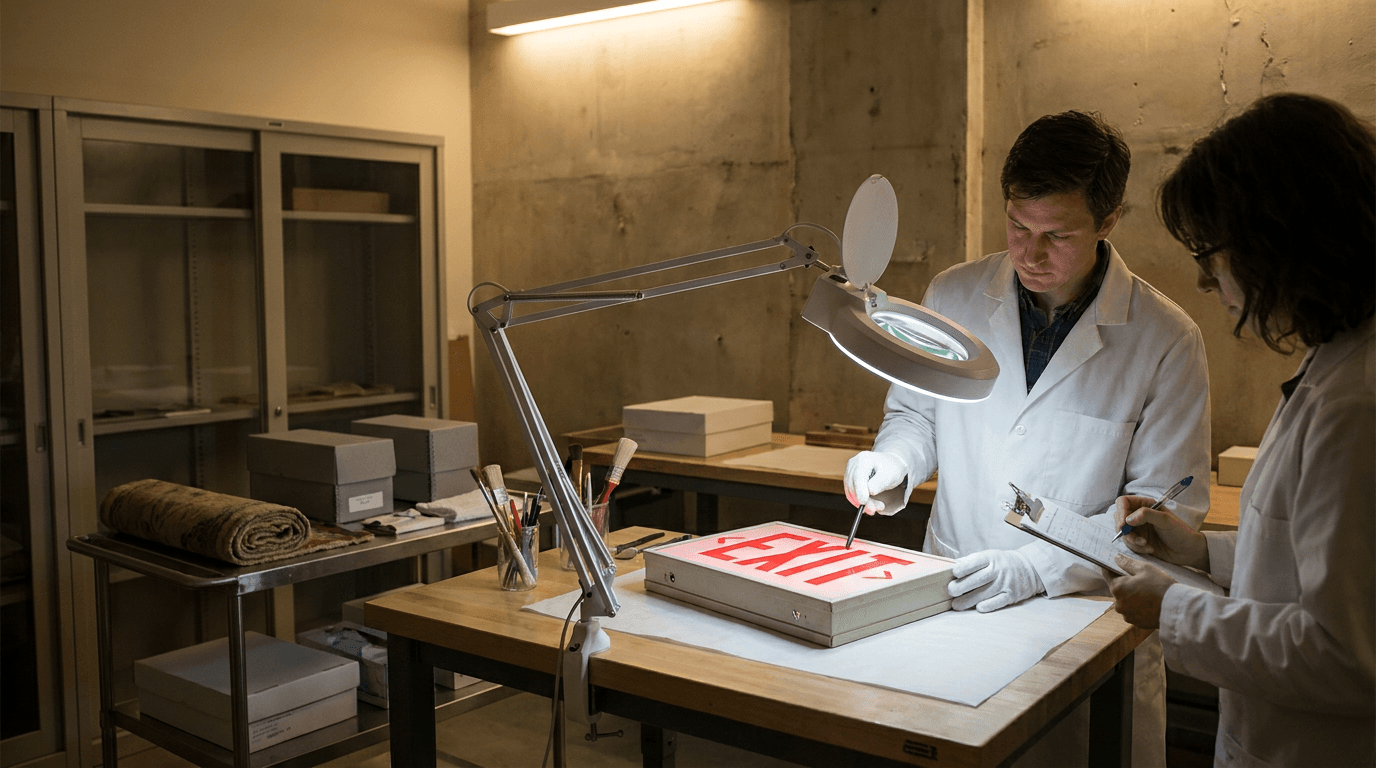
The sign, mounted above the north stairwell and previously understood as part of the building's life-safety system, will now be presented as Untitled (Way Out), a formative example from Emergency's mature directional period. It will remain connected to backup power while being understood as a luminous proposition about departure, obligation, and the public's long relationship with green plastic.
"Emergency has always worked at the boundary between command and care," said Lenna Harth, chief curator of necessary objects. "This piece asks us to leave, but also to ask who taught us where out is."
Revised Attribution
The museum said the change followed a six-month audit of objects that had been guiding visitors without the benefit of wall text. Conservators reviewed installation records, fire code diagrams, and several incident reports in which the sign demonstrated what Harth called "a sustained commitment to legibility under pressure."
The new label lists Emergency as "active whenever conditions require" and dates the work to the building's 1987 renovation, with later conservation performed during a 2014 battery replacement. Curators declined to classify the glowing arrow as a collaborator, saying the arrow's role remains "directional but not authorial."
Visitors may now stand near the sign for up to four minutes, provided they do not actually exit during interpretive programming. Docents have been trained to distinguish between guests who are engaging the work and guests who are leaving because a bus is waiting.
Functional Concerns
Museum officials emphasized that the sign will continue performing its emergency duties, though its new status requires additional care around crowd flow. A thin line on the floor marks the recommended viewing distance, with a second line reserved for people who need to obey the sign immediately.
"We are not asking the public to choose between aesthetic attention and survival," said facilities director Mora Chane. "We are simply giving them a more complete context for both."
Security guards have been instructed not to shush the sign, even when its glow creates what some visitors have described as a strong opinion. The museum also asked guests not to photograph the work with flash, noting that the piece is already illuminated and does not need encouragement.
Public Response
Several visitors said the label made the hallway feel more deliberate. One patron reported that she had walked past the sign for years without realizing it had been leaving instructions in a recognized visual language.
"I used to think it was telling me where the stairs were," said Malia Fern, who attended the morning preview. "Now I understand that it was asking me to prepare emotionally for them."
The museum store has ordered postcards, magnets, and a pocket-sized catalogue titled Emergency Before the Alarm. A children's workshop will invite students to make their own exit signs, then explain why no one should follow them.
What Happens Next
Harth said the museum is preparing a companion exhibition on fire extinguishers, alarm pull stations, and the small metal plate that insists certain doors remain closed. Loan agreements are still pending with the Department of Knowing What To Do.
"The building has been full of instruction," Harth said. "We are only beginning to understand how much of it has been looking at us."
Commercial notice