Late fees will continue to accrue while the books maintain posture.
Library Board Requires Overdue Books to Sit Upright in Court
The library says delinquent titles must appear in municipal court unaccompanied unless borrowers file a binding spine exemption.
By Mara Vellum, Politics and Civic Procedure Editor
JULIARD CITY - Published June 6, 2026 at 7:16 PM CDT
Commercial notice
The Library Board voted Saturday to require overdue books to appear upright in municipal court, formalizing a long-running practice in which delinquent titles were allowed to lie flat while borrowers handled the consequences.
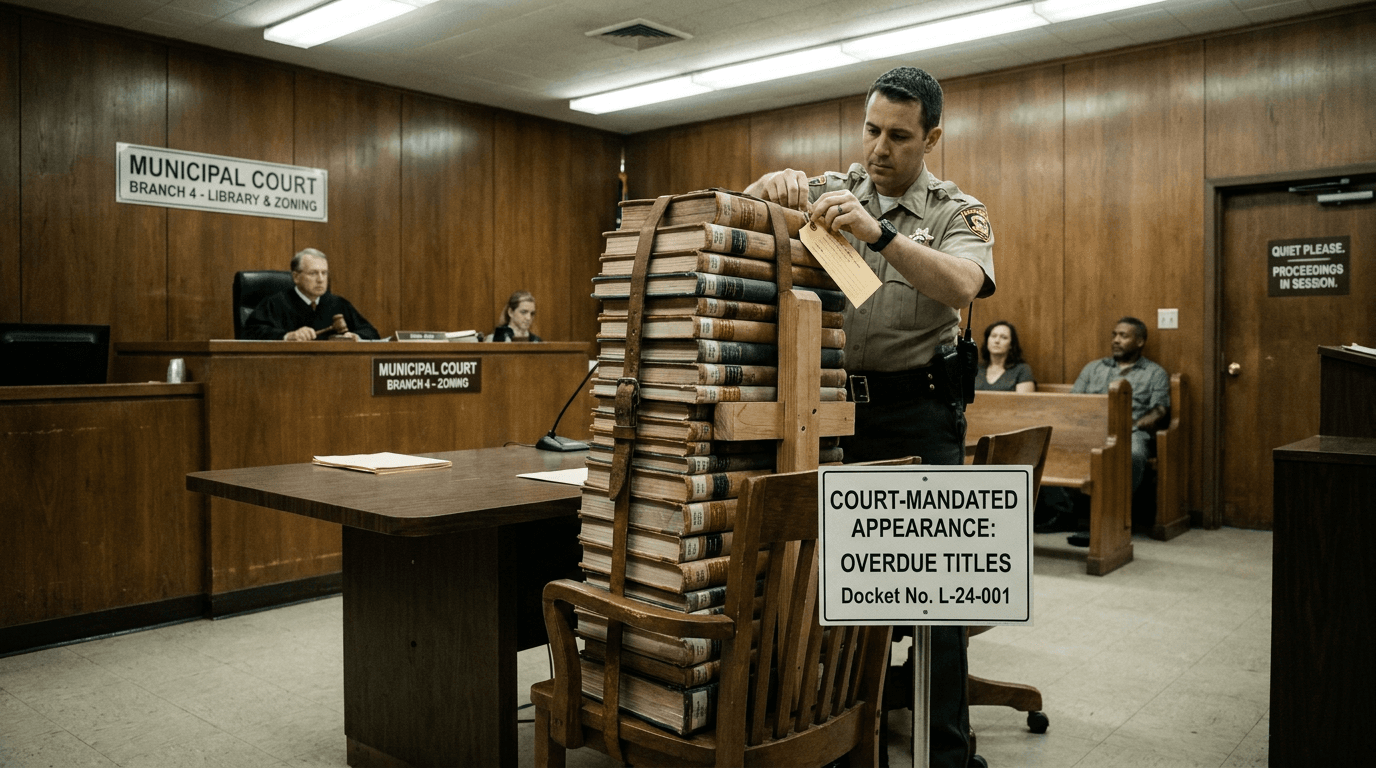
Under the new rule, any book more than 30 days overdue must be transported to court in a protective cart, placed at the defense table, and positioned with its spine visible to the clerk. Borrowers may attend, but the board said the book itself must face the docket.
"A borrower can explain circumstances," Library Director Sella Morne said. "But the book is the public asset that failed to return. It should at least sit up."
A Matter Of Shelf Integrity
Officials said the posture requirement is meant to restore dignity to overdue proceedings and protect the shelf from having to absorb every absence without witness. Books that cannot remain upright because of age, binding damage, or excessive beach exposure may request a spine exemption before the hearing.
The court has ordered a small set of bookstands for paperbacks, children's titles, and certain ambitious histories that lean under their own certainty. Bailiffs will receive training on page support, dust jacket sensitivity, and the correct way to swear in a reference volume.
"We are not punishing literature," Morne said. "We are inviting it to participate in accountability."
Borrower Response
Some residents said the hearings have made overdue materials harder to ignore. One borrower described seeing a cookbook seated beside him under fluorescent court lights as "a level of disappointment I had not expected from sauces."
Library advocates praised the change for distinguishing between ordinary lateness and prolonged shelf absence. Critics said the rule may intimidate readers who already feel judged by bookmarks.
Continued Cases
The first docket included 18 novels, two language guides, and one paperback mystery that requested a continuance after sliding down its stand. The judge remanded it to the returns desk pending further posture review.
Commercial notice