Researchers said the planet's orbit is stable but badly organized.
Astronomers Discover Minor Planet Mostly Used for Storage
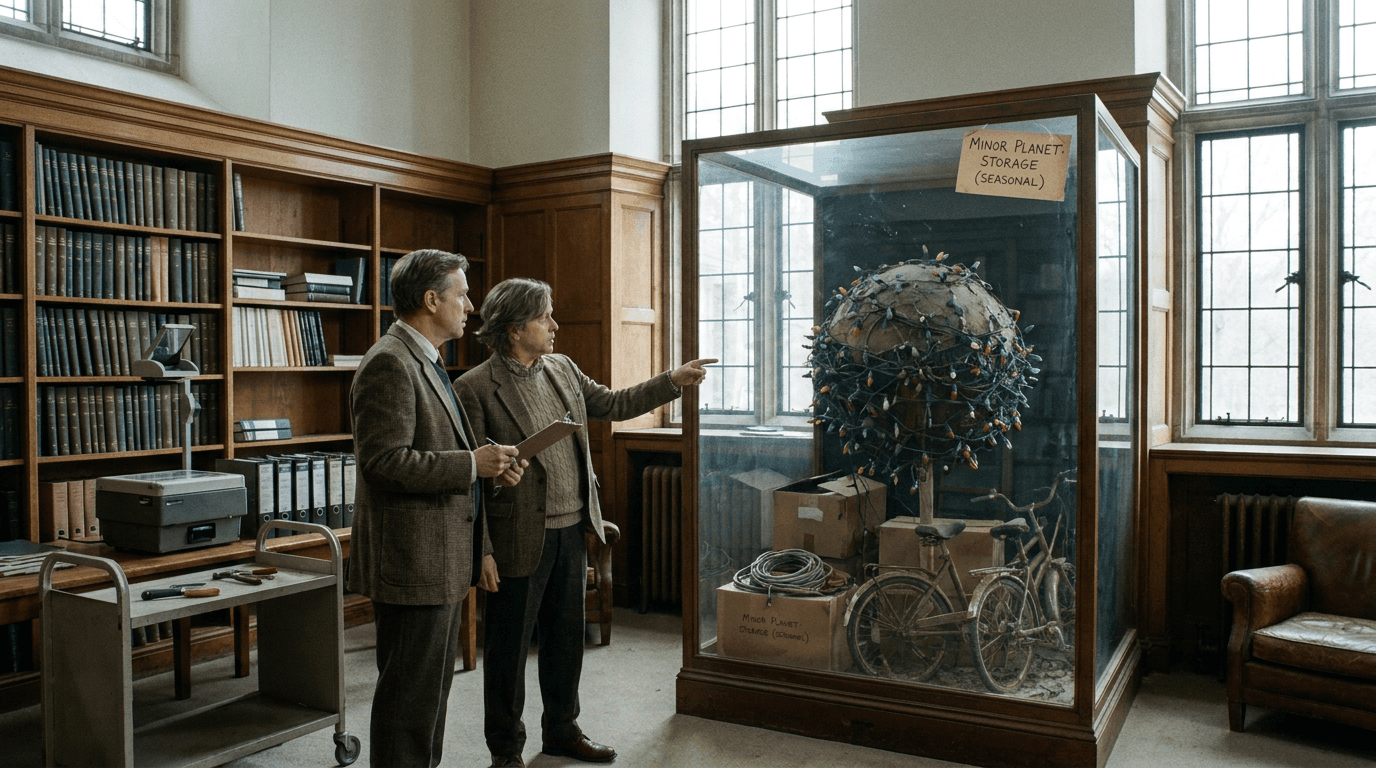
The distant body appears to contain seasonal decorations, outdated chargers, and several boxes labeled for a future nobody scheduled.
By Dr. Veda Sill, Science and Technology Correspondent
INSTITUTE CORRIDOR - Published June 6, 2026 at 4:04 PM CDT
Commercial notice
Researchers said Saturday they have discovered a minor planet that appears to be used mostly for storage, after telescope images revealed seasonal decorations, obsolete adapters, and a tarp-secured region along the northern hemisphere.
The object, observed beyond the main asteroid belt, was initially mistaken for an ordinary rocky body until astronomers noticed repeated rectangular formations, several color-coded lids, and what appears to be a folding chair leaning against a crater for later.
"At first we classified it as debris," said Dr. Venn Arlo, an observational astronomer with the Institute for Distant Objects. "Then we realized much of the debris had been placed in categories."
The planet has not been formally named. For now, the team refers to it as Minor Planet 8842-H, with the H standing for "hold onto this in case."
What The Images Show
High-resolution scans indicate the planet is roughly 14 miles across and moderately organized near the front-facing hemisphere. Researchers identified stacked plastic bins, a collapsed artificial tree, several chargers for devices no longer supported by their manufacturers, and a cardboard box labeled "good mugs" despite containing only cables.
A large equatorial ridge appears to be composed of things someone moved there temporarily.
The southern hemisphere is less clear. Images show tarps, bungee cords, and a narrow path that seems to have been maintained only until it reached another pile. Astronomers said they cannot yet determine whether the back side of the planet contains useful objects or merely objects that once made being useful plausible.
"The orbit is stable," Arlo said. "The storage plan is not."
Spectral analysis found traces of dust, ice, packing tape, and a sentiment signature associated with keeping something because it belonged to a previous version of the household.
Scientific Reaction
The discovery has raised questions about whether storage behavior is more common in the solar system than previously understood. Astronomers have long known that small bodies can collect rubble, but a world dedicated to deferred sorting suggests a level of intention not usually assigned to minor planets.
The International Minor Planet Center said it would review the object after determining whether its contents affect classification. Current categories include asteroid, dwarf planet, trans-Neptunian object, and "utility body pending inventory."
Home organization companies have also contacted the institute, asking whether remote consultation could be performed at astronomical distance. Researchers said any such work would first require mapping the planet's walkable surfaces and locating the lid for a container seen near the western basin.
Public response has been immediate. Several households asked whether a minor planet could accept off-site donations of things that are not garbage but cannot be allowed to remain in a closet with regular objects.
"We are not opening a municipal service," Arlo said. "We are observing one, apparently."
Next Observations
The team plans to revisit the planet during its next favorable alignment, when sunlight should reach the region behind a ridge described in the paper as "where the extra shelves went."
Researchers also hope to determine ownership. Early models suggest the planet may not belong to a single civilization but to a broad pattern of postponement distributed across space.
Until then, the institute has advised against sending additional material to the planet, even neatly labeled.
"There is always a temptation to use empty space as a solution," Arlo said. "This object shows what happens when the space begins keeping receipts."
Commercial notice