The discovery could transform architecture, packaging, and certain family gatherings.
New Material Bends Under Expectation but Not Weight
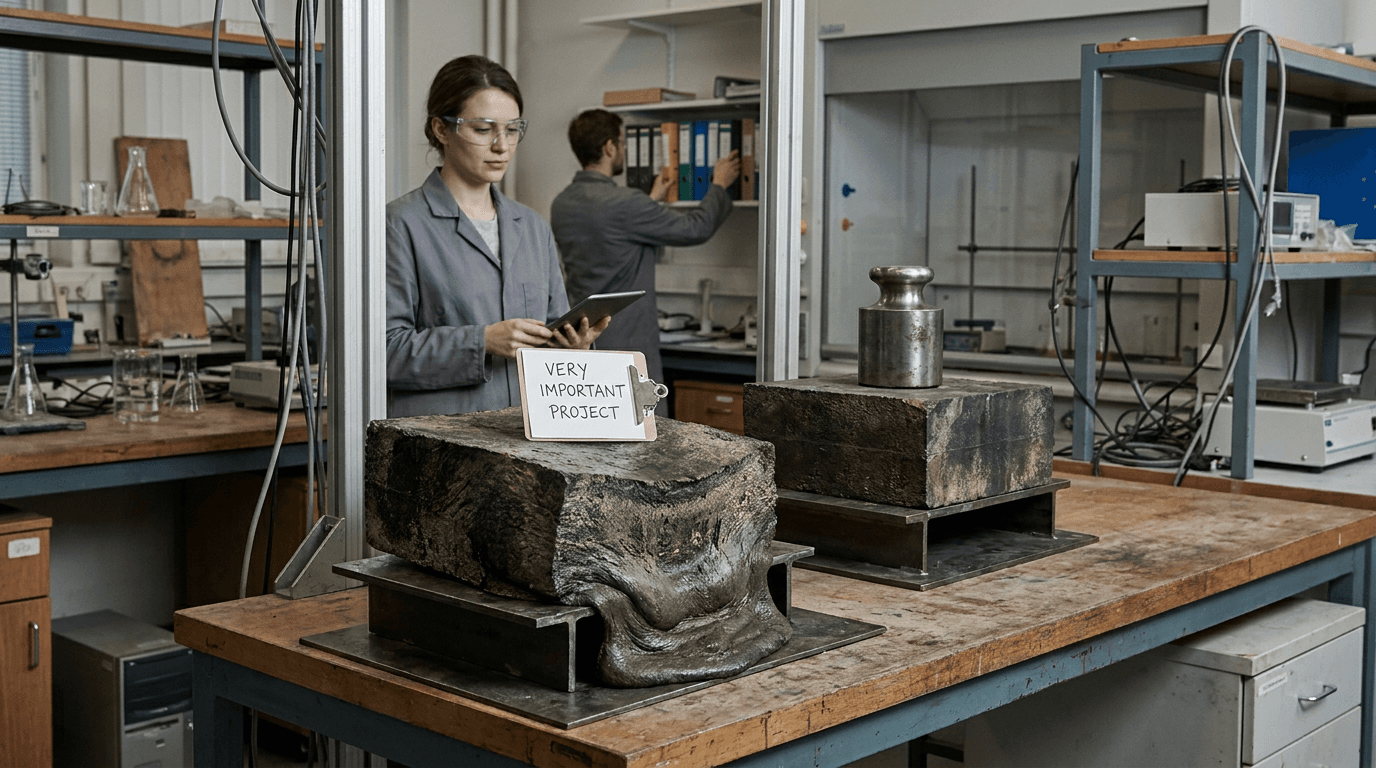
Engineers say the material remains rigid under pressure yet droops immediately when asked to become important.
By Dr. Veda Sill, Science and Technology Correspondent
INSTITUTE CORRIDOR - Published June 6, 2026 at 4:21 PM CDT
Commercial notice
Researchers said Saturday they have developed a material that bends under expectation but not weight, remaining rigid beneath concrete blocks, hydraulic presses, and industrial clamps before drooping almost immediately when described as promising.
The material, a composite sheet provisionally classified as E-17, was created by engineers at the Institute for Applied Load Bearing after conventional stress tests failed to account for the pressure of being important in front of people.
"We have many materials that can handle force," said Dr. Havel Brin, the project lead. "We had not adequately studied what happens when a material is told it could really make a difference."
According to the research team, E-17 can support several tons without deformation. It begins to bend when exposed to expectations, especially in the form of grant language, investor interest, family confidence, or a quiet room waiting for it to perform.
The First Failure
The discovery occurred during a routine demonstration in which engineers placed E-17 under a stack of calibrated weights. The sample held steady for three hours. It also remained stable beneath a forklift, a suspended water tank, and a visiting administrator who stood on it briefly after being assured that was allowed.
The beam bent only after a researcher reviewing the data said, "This could be big."
"At first we assumed a measurement error," Brin said. "Then someone called the result exciting, and the material folded another nine degrees."
To isolate the effect, engineers created a testing room where the sample was exposed to different forms of expectation. Neutral statements such as "this is a material" produced no response. Mild encouragement caused surface rippling. The phrase "everyone is counting on this" led to immediate structural compromise and a noise several staff members described as familiar.
The material showed particular sensitivity to phrases printed in bold on presentation decks. It also weakened when placed near a whiteboard labeled "future applications."
Potential Uses
Despite the limitation, manufacturers have expressed interest in E-17 for specialized roles. Because it performs well under ordinary weight, the material could be useful in shelving, temporary platforms, and furniture intended for people who have not discussed its potential.
Engineers said the material may also help scientists quantify expectation as a load category, something long recognized informally in classrooms, offices, weddings, and holiday travel.
"A bridge can be measured for vehicle weight," Brin said. "A person bringing salad to a family dinner has historically been on their own."
The institute is advising companies not to overstate E-17's promise in marketing materials. Draft packaging recommends the product be described as fine, probably useful, and available. A warning label under review reads: "Do not inspire before installation."
Investors asked whether the material could be trained to tolerate ambition. Researchers said early exposure therapy was unsuccessful after a sample warped during a brainstorming session and had to be stored flat under a towel.
Further Testing
The next phase will examine whether expectation travels through adjacent materials. In one preliminary trial, an ordinary metal bracket began to sag after being told it was part of an important system.
The team is also testing soundproof shipping crates to prevent E-17 from overhearing procurement meetings.
For now, Brin said the material is stable as long as it is treated with practical indifference.
"It is not fragile," he said. "It simply prefers not to be believed in while carrying things."
Commercial notice