The finding could explain why errands briefly feel recoverable near doorways.
Researchers Isolate Particle Responsible for Almost Remembering
The lab says the particle appears when people enter rooms with purpose, pause, and negotiate silently with nearby shelves.
By Dr. Veda Sill, Science and Technology Correspondent
JULIARD CITY - Published June 5, 2026 at 11:30 AM CDT; updated June 6, 2026 at 9:15 PM CDT
Commercial notice
Researchers at the Institute for Applied Uncertainty said Friday they had isolated the particle responsible for almost remembering, a subcognitive unit that appears to form whenever a person enters a room, stops, and waits for the room to explain why they came in.
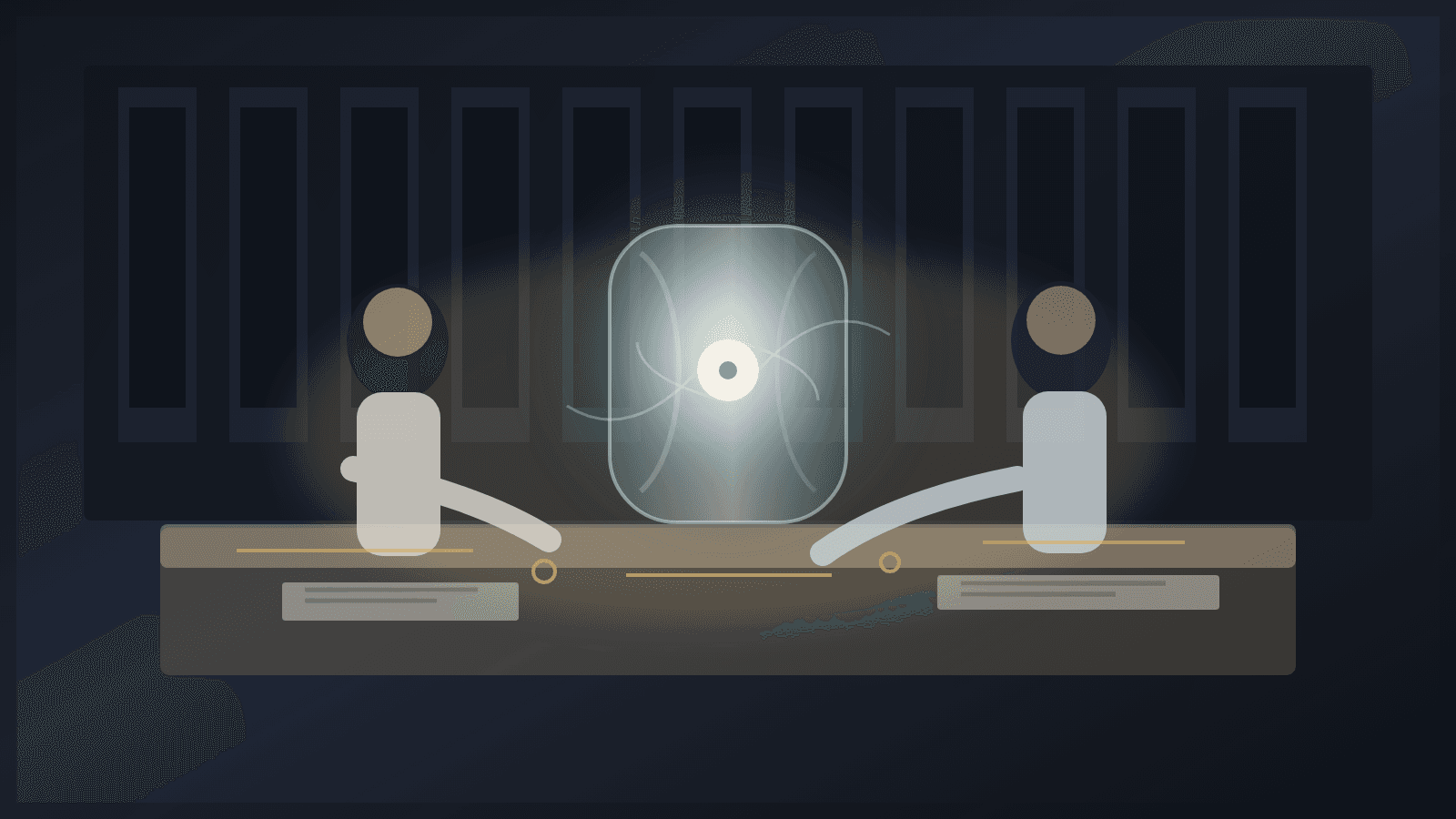
The particle, provisionally named the mnemon, was observed inside a chilled glass chamber after a team of scientists placed a set of ordinary household intentions under controlled conditions. The intentions included retrieving scissors, checking whether laundry had become political, and walking confidently toward a shelf without a plan.
"For decades, memory science has focused on recall and forgetting," said Dr. Elian Rusk, the institute's director of transitional cognition. "We are now able to observe the narrow luminous interval in which the mind knows it had a reason and resents being asked to produce it."
According to the research team, the mnemon does not contain the forgotten information. Instead, it carries the feeling that the information is standing just behind a curtain, holding a clipboard, and refusing to make eye contact.
How the Particle Was Found
The discovery came after researchers noticed a recurring flicker in the lab's hesitation chamber, a windowless room furnished with a coat hook, a single envelope, and a kettle that had been unplugged for ethical reasons.
Volunteers were asked to begin a simple task, walk through a doorway, and then describe the shape of the thought that remained. Sensors recorded a brief surge of near-certainty, followed by what the paper calls "administrative fog."
"The particle consistently appeared between confidence and shrugging," Rusk said. "It lasted less than a second, but in that second it seemed to know every drawer in the building."
The institute said the mnemon is most stable near refrigerators, open browser tabs, and bags that have been set down too carefully. It becomes harder to detect when subjects are asked directly what they were doing.
Practical Uses Remain Unclear
The finding has drawn cautious interest from appliance manufacturers, productivity consultants, and the Department of Disciplined Events, which issued a statement calling the particle "potentially relevant to meetings that begin with purpose and end near a pastry."
Researchers warned that practical applications remain years away. Early proposals include a doorway sensor that whispers "keys," a household lamp that brightens when the user is about to forget why they stood up, and a municipal registry for intentions that fail to reach their destination.
Ethicists have raised concerns that commercializing the mnemon could place additional pressure on people to remember errands that were never very good.
"Some forgetting is a public service," said Ren Voss, chair of the institute's review board. "If every almost-thought becomes recoverable, society will have to reckon with a lot more cabinet organization."
The Next Study
The institute plans to begin a second trial this summer examining whether the particle can distinguish between a forgotten task and the sudden suspicion that someone has replied to an email in the wrong tone.
For now, researchers said the discovery should reassure anyone who has stood motionless in a hallway with one finger raised, convinced that meaning was nearby.
"That moment is not emptiness," Rusk said. "It is a very small particle doing paperwork."
Commercial notice